
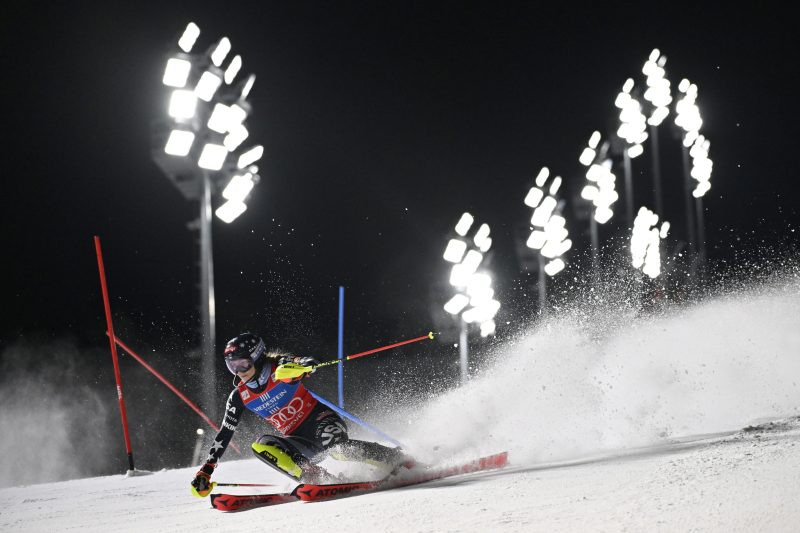
- Mikaela Shiffrin won her fourth consecutive slalom race of the season in Courchevel, France.
- The victory marked her 105th career World Cup win, extending her own record.
- Shiffrin is winning by significant margins, often over a full second, in a sport decided by hundredths.
- Despite difficult and icy course conditions that caused many other skiers to not finish, Shiffrin maintained her form.
Mikaela Shiffrin’s winning streak goes on.
It was the 105th World Cup win of her career, extending her own record. The win increases her leads in both the overall and slalom season standings.
‘I’m just pushing. I don’t know (and) I’m not asking questions,’ Shiffrin said when asked to explain her win streak. ‘Sometimes you’ve just got to take it and roll with it because these women are pushing. They’re pushing like hell. So I have to push, too.’
Paula Moltzan is one of those pushing, skiing the fastest second run to move up four spots to fifth place. It’s her third top-five finish this season; she was eighth at Copper Mountain 2½ weeks ago.
Shiffrin isn’t just winning. She’s winning by massive margins
Impressive as Shiffrin’s win streak is, it’s the dominance of those wins that’s so remarkable. Including Tuesday, when she beat Switzerland’s Camille Rast by 1.55 seconds, Shiffrin has won each slalom race by 1.23 seconds or more.
In a sport often determined by tenths and hundredths of seconds, those are massive margins. Put another way: There was a greater margin between Shiffrin and Rast on Tuesday than between Rast and Wendy Holdener, who was seventh.
If Shiffrin keeps this up, it won’t be enough for her competitors simply to ski well. They’ll need Shiffrin to make mistakes, and that’s something she’s just not doing.
The track in Courchevel was nasty, rutted and icy beneath a thin covering of snow. There were 17 DNFs in the first run, including three of the first six skiers, and another six in the second run. They included Albania’s Lara Colturi, who was second to Shiffrin in the first to slaloms and third in the third, and contenders Lena Duerr and Sara Hector.
But Shiffrin used the conditions to her advantage, rather than letting them jostle her about. Even when she did make mistakes, she was able to quickly recover rather than allowing the error to take her out of her rhythm.
Ahead of the first run, Shiffrin’s team warned her that the course was picking up speed and told her to stick to her plan. She fought through the first few gates, and was just 0.06 seconds ahead of then-leader Rast after the first sector.
But Shiffrin settled in, looking more and more fluid the further down the course she got. By the time she crossed the finish line, Shiffrin was 0.83 seconds ahead of Rast, who raised her hands in a ‘What can you do?’ gesture.
‘Everybody on the first run made some kind of mistakes. It was just really important to be moving and very dynamic,’ Shiffrin said. ‘I executed that very well. That was the big separator.’
With such a big lead going into the second run, Shiffrin just had to stay aggressive. She was slow out of the gate, but was able to find speed after the first sector. She was flying during the second half of the course, her winning streak secure.
‘Some of it is lock in this feel,’ Shiffrin said when asked what she’ll do with the break she now has before her next race.